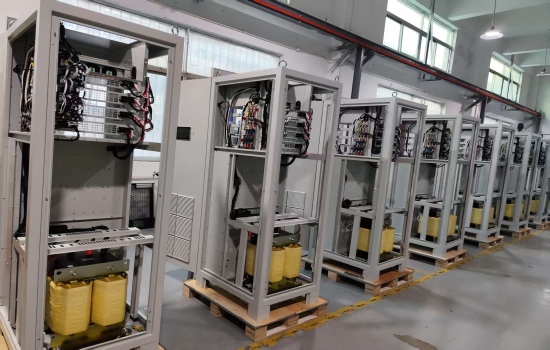
Outdoor Product Series
  • Analysis of the Application and Core Advantages of Industrial UPS in Industrial Automation Analysis of the Application and Core Advantages of Industrial UPS in Industrial Automation Jun 07, 2025
    What are the applications and advantages of industrial UPS in industrial automation?   In industrial automation scenarios, millisecond-level power anomalies may cause production lines to be paralyzed or equipment to be damaged. As the "energy guardian" of key facilities, industrial-grade uninterruptible power supply (UPS) provides stable power guarantee for complex working conditions with its unique technical characteristics. This article will systematically analyze its technical advantages and cross-industry practical value.   Three major technical features of industrial UPS   1. Dynamic load compatibility Supports 150% instantaneous overload, effectively dealing with the starting current impact of motors, inverters and other equipment Three-phase voltage balancing technology ensures stable operation of 400V-class equipment (fluctuation range <±0.5%)   2. Adaptability to harsh environments Wide temperature range operation design (-25°C to +60°C), IP54 protection level to resist dust, oil and humid environment Seismic structure verified by international standards (5–500Hz random vibration test)   3. Long-term operation stability The mean time between failures of core components exceeds 200,000 hours Intelligent battery management system extends the life of energy storage units by more than 40%)   Power guarantee mechanism of industrial automation system   1. Precision control unit protection Provide pure power for control systems such as PLC and DCS to eliminate program disorder caused by voltage fluctuations Practical case: After an automobile manufacturer deployed industrial UPS, the failure rate of production line robots decreased by more than 90%   2. Special power problem management Effectively suppress 6kV/3kA level surge impact and protect variable frequency drive equipment Harmonic filtering capacity reaches more than 30% (in line with international power quality standards)   3. Intelligent operation and maintenance system Real-time monitoring of power parameters, 48 ​​hours in advance warning of battery abnormalities Support remote upgrade, compatible with mainstream industrial communication protocols   CONSNANT Industrial Online UPS System:   ------3P/3P CNI330 10-300KVA  & 3P/1P CNI310 10-120KVA   Nominal Voltage: 380/400/415VAC Maximum Input Voltage Range: +-20% Nominal Frequency: 50/60HZ   Application field: Power Plant DCS Control System Boiler Safety Monitoring System Steam turbine inspection Bypass systems and other automatic protection devices Petrochemical, natural gas, plastics, production lines laboratory testing equipment   Key points of system configuration Capacity planning: Using the dynamic load factor method, it is recommended to reserve 20%-30% redundancy Architecture selection:        Online double conversion: the first choice for precision instruments (harmonic distortion <3%)        Modular structure: supports elastic expansion needs Energy storage solution:        Lithium battery system is preferred for high temperature scenarios (cycle life is increased by 3 times)        When paired with a generator set, configure the backup time at 1:1.2   With the deepening of smart manufacturing and green production concepts, industrial UPS is transforming from a single power supply device to a smart energy management node. While ensuring production continuity, it also drives the continuous evolution of industrial facilities towards efficiency and digitalization.
  • Differences between CONSNANT industrial UPS systems and commercial UPS systems Differences between CONSNANT industrial UPS systems and commercial UPS systems Nov 06, 2025
    Commercial UPS systems are designed for use in IT applications, such as computer rooms and data centre environments. They are intended to provide power protection for electronic equipment, such as servers, workstations, and networking equipment, and to prevent data loss or corruption in the event of a power outage.   On the other hand, CONSNANT Industrial UPS systems are designed for use in more demanding environments, such as those found in critical process control, like a nuclear power plant or an oil rig. These environments require a more robust and reliable power protection solution due to the critical nature of the processes and the potential consequences of power outages.   CONSNANT Industrial UPS systems are designed and performance tested to a more rigorous level than commercial systems. They are built to withstand harsh environments and extreme temperatures, and they can tolerate moderate amounts of non-conductive dust. These industrial UPS have to have longer battery runtime, redundant and parallel systems, and the possibility to connect with different kinds of generators. Furthermore, in industrial environments, the interruption of AC power may cause dangerous chemical process instability or cause expensive damage to processing systems. whereas in light industrial applications, like pharmaceutical manufacturers or in the food and beverage industry, loss of AC power may not present a dangerous situation but the loss of product and production time can be costly.   Overall, the choice between commercial and industrial UPS systems will depend on the specific requirements of the application and the level of power protection that is needed. It's important to have a good understanding of the environment and loads that will be connected to the UPS to ensure that the appropriate system is selected.   Core Difference Comparison Table Feature/Dimension Commercial UPS Industrial UPS Design Goal & Core Philosophy Cost-effectiveness, Space Efficiency, Ease of Use Maximum Reliability (MTBF), Durability, Maintainability Typical Application Scenarios Data Centers, Server Rooms, Network Closets, Office Computers, POS Systems Petrochemical, Power Generation, Steel, Manufacturing,Transportation, Maritime, Mining, Semiconductor Plants Load Type IT Equipment (Servers, Switches, Storage, etc.) Industrial Control Systems (DCS/PLC/SCADA), Motors, Variable Frequency Drives, Actuators Operating Environment Clean, Controlled EnvironmentTemperature: 0-40°CHumidity: Relatively StableNo Conductive Dust Harsh, Severe EnvironmentTemperature: -20 to +55°C or widerHumidity: Can be very high or lowPresence of Dust, Oil, Corrosive Gases, Vibration Input Voltage Range Relatively Narrow, requires good grid quality Very Wide, can tolerate severe grid fluctuations (e.g., ±25% or higher) Input Harmonic Handling Optional feature, maybe low on standard models Typically standard with high-level input filters, prevents polluting the grid, meets strict standards Output Performance Stable voltage, suitable for resistive loads High surge capability, can handle inrush currents from inductive loads like motor starts Battery & Runtime Standard short runtime (5-15 mins), batteries internal or in same room Long backup time design (several hours), uses industrial spill-proof batteries, separate battery cabinets possible Construction & Cooling Compact chassis, Fan Cooling, front-in/rear-out airflow Robust steel structure, High IP Protection Rating (e.g., IP42), Sealed cabinets, forced air duct cooling Maintainability & MTTR Modular design (some models), but requires on-site specialist repair Fully modular, hot-swappable design, very short Mean Time To Repair (MTTR), supports online maintenance Lifecycle & Cost Shorter lifecycle (3-5 years), Lower initial cost Long lifecycle (10-20 years), High initial cost, but lower Total Cost of Ownership (TCO)   CONSNANT Industrial UPS Typical Application: Manufacturing Power generation and distribution Transportation Oil and gas Medical Government and military facilities Industrial automation
  • CONSNANT IP44 Industrial Online UPS: A Benchmark for Industrial-Grade Power Safety CONSNANT IP44 Industrial Online UPS: A Benchmark for Industrial-Grade Power Safety Nov 25, 2025
      As a professional importer and exporter of online UPS power supplies, CONSNANT, with decades of experience in the power supply field and a professional technical team composed of senior engineers, is committed to providing stable, reliable, and efficient power solutions for industrial customers worldwide. Among its flagship products, the CONSNANT IP44 Industrial Online UPS, with its superior performance and precise scenario adaptability, has become the preferred equipment for power protection in the industrial field.   I. IP44 High Protection Rating, Adaptable to Complex Industrial Environments   Industrial production scenarios are often accompanied by problems such as dust and large humidity fluctuations, making it difficult for ordinary UPS power supplies to adapt to such harsh conditions. The CONSNANT IP44 Industrial Online UPS adopts a stringent protection design, meeting the IP44 protection standard, and possesses excellent dustproof and splashproof capabilities. Whether in dusty indoor environments such as machine shops and metallurgical plants, or in outdoor operating environments such as communication base stations and new energy power plants, this product can effectively resist external environmental interference, maintain stable operation, and provide continuous and uninterrupted power support for industrial equipment.   II. Online Double Conversion Technology for Zero-Interruption Power Supply   For industrial production, even millisecond-level power outages can lead to serious consequences such as production process disruptions, damage to precision equipment, and data loss, resulting in significant economic losses. The CONSNANT IP44 Industrial Online UPS features advanced online double conversion technology, which monitors the power grid status in real time. When voltage fluctuations or power outages occur, it can switch from grid power to battery power within zero milliseconds, achieving true uninterrupted power supply. This core advantage ensures the continuous and stable operation of critical equipment such as CNC machine tools, automated production lines, and industrial control systems, minimizing the impact of power failures on production.   III. Intelligent Management and Multiple Protections for Efficiency and Safety   In the trend of intelligent manufacturing, the manageability and safety of equipment are increasingly important. The CONSNANT IP44 Industrial Online UPS has a built-in intelligent battery management system that accurately monitors battery parameters such as voltage, current, and temperature, automatically performing charge and discharge balancing adjustments to effectively extend battery life and reduce maintenance costs. Meanwhile, the product is equipped with a comprehensive protection mechanism, covering multiple functions such as overload protection, short circuit protection, overvoltage protection, and undervoltage protection. It can monitor the circuit status in real time and immediately activate the protection program in case of any abnormality, preventing equipment damage due to power problems and ensuring the personal safety of operators.   IV. Professional Technical Backing, Globally Trusted Quality   CONSNANT has always regarded technological research and development as its core competitiveness. Its professional technical team not only possesses a strong theoretical foundation but also rich practical experience in industrial scenarios. During the development of the IP44 Industrial Online UPS, the team combined the characteristics of industrial power consumption in different regions around the world with customer needs, conducting repeated testing and optimization to ensure that the product achieves industry-leading levels in performance, stability, and compatibility. With its superior quality and comprehensive after-sales service, the CONSNANT IP44 Industrial Online UPS has been exported to many countries and regions worldwide, widely used in numerous industrial fields such as automotive manufacturing, electronics, new energy, and chemicals, winning high recognition and trust from global customers.   From adaptability to harsh environments to zero-interruption power supply, from intelligent management to comprehensive safety protection, the CONSNANT IP44 Industrial Online UPS, with its robust capabilities, builds a solid power safety barrier for industrial production. In the future, CONSNANT will continue to uphold its commitment to technological innovation, further deepen its expertise in the industrial UPS field, and provide global industrial customers with more competitive power solutions, helping enterprises achieve efficient, stable, and safe production operations.   Welcome to inquire: Shenzhen Consnant Technology Co,Ltd. E-mail: sales@consnant.com Web: www.consnant.com
  • Differences & Advantages: 6-Pulse vs 12-Pulse Rectifier for Consnant Industrial Online UPS Differences & Advantages: 6-Pulse vs 12-Pulse Rectifier for Consnant Industrial Online UPS Apr 17, 2026
    Based on the application scenarios of Consnant CNI series industrial online UPS, the core differences between 6-pulse and 12-pulse UPS lie in rectifier structure, harmonic suppression capability, grid compatibility, and overall cost. 12-pulse UPS offers superior grid friendliness, stability, and efficiency, making it suitable for harsh industrial environments; 6-pulse UPS, on the other hand, excels in low cost and simple structure, making it suitable for standard scenarios.   1. Core Structural Difference 6-Pulse Rectifier Uses a 6-SCR full-bridge topology, generating 6 current pulses per AC cycle. Simple design, compact size, lower cost.   12-Pulse Rectifier Based on the 6-pulse rectifier, a phase-shifting transformer and a second 6-pulse rectifier bridge are added, for a total of 12 thyristors. The transformer shifts the input voltage phase by 30°, and the two bridges are connected in parallel and superimposed to form 12 pulses/cycle. More complex structure, higher reliability for industrial use.   2. Comparison of Key Performance Characteristics of Industrial UPS Item 6-Pulse 12-Pulse Advantage Input THDi ~25%–30% ~8%–10% 12-Pulse Power Factor (PF) ~0.8 >0.95 12-Pulse Harmonic Profile Dominated by 5th, 7th harmonics 5th, 7th harmonics largely canceled 12-Pulse Grid Impact May cause overheating, interference, generator instability Minimal grid pollution 12-Pulse Efficiency Slightly higher Slightly lower (transformer loss) 6-Pulse Size & Weight Smaller, lighter Larger, heavier 6-Pulse Cost Lower Higher 6-Pulse Redundancy Single bridge Dual-bridge, partial load capability if one fails 12-Pulse   3. Core Advantages of 12-Pulse Transmission over 6-Pulse Transmission (Industrial Scenarios)   a. Ultra-Low Harmonics, Grid-Friendly Significantly suppresses 5th and 7th order low harmonics (a major cause of grid pollution). THDi <10%, meeting IEC 62040-3 industrial standards without additional filters. Protects transformers, generators, and precision instruments in the plant area from harmonic interference.   b. Compatible with Generators and Sensitive Loads 6-pulse transmission with filters can easily lead to generator voltage runaway and shutdown under light loads. 12-pulse transmission is stable across the entire load range, perfectly matching backup generators.   c. High Power Factor, Energy Saving and Cost Reduction PF close to 1, reducing reactive power losses and lowering electricity costs and distribution capacity requirements.   d. Industrial-Grade Reliability and Redundancy Dual rectifier bridge design, strong fault tolerance. Lower ripple, more stable DC bus, extending battery and inverter lifespan.   4. Applicable Scenarios for 6-Pulse (Consnant CIN Basic Version) • General industrial environments with limited budgets, good power grid quality, and no sensitive equipment. • Workshops/factories with stable loads, long-term full-load operation, and low harmonic requirements. • Scenarios with limited space and requiring miniaturized installation.   5. Consnant CNI Series Selection Recommendations • Choose 6-Pulse: Standard operating conditions, cost priority, clean power grid, no precision equipment. • Choose 12-Pulse: Demanding industrial scenarios such as data centers, power plants, chemical plants, semiconductor plants, and medical facilities; projects requiring backup generators, protection of high-precision equipment, long-term stable operation, and high compliance requirements.   Optimize Your UPS: 6-Pulse or 12-Pulse?Contact Consnant for professional solutions.
  • Replacing an Industrial UPS: What Information Should a Plant Gather Before Selecting a Replacement? Replacing an Industrial UPS: What Information Should a Plant Gather Before Selecting a Replacement? Oct 28, 2026
    For manufacturing plants, chemical facilities, water treatment sites and process automation workshops, the industrial UPS protects mission-critical loads: DCS control systems, PLC hosts, sensors, safety interlock devices and monitoring instruments. An aging UPS faces rising failure risk, spare part shortages and low efficiency. Rushing into replacement without a complete data survey often leads to mismatched capacity, incompatible wiring, insufficient backup runtime or expensive rework. Before selecting a replacement industrial online UPS, maintenance and electrical teams must collect structured site data. This checklist helps you define requirements clearly and select a reliable industrial UPS solution such as Consnant CNG low-frequency industrial UPS and CNH high-frequency industrial UPS series. 1. Existing UPS & Load Profile Data Start by auditing the current UPS and real load conditions, not only the nameplate values. Old UPS model, rated kVA/kW, output power factor, phase configuration (3/3, 3/1, 1/1), topology (online double conversion) Actual measured load (not just nameplate sum): steady-state load, inrush current from motors, periodic surge load Critical load list: DCS, PLC, emergency instruments, SCADA, actuators; separate non-critical loads that can be removed from the UPS bus Load tolerance: voltage sag tolerance, harmonic sensitivity, whether zero transfer time is mandatory Future expansion margin: 20%–30% spare capacity is recommended for new production lines or additional control cabinets Consnant industrial UPS supports output power factor 1.0, which delivers more real power for modern switching power loads common in automation control rooms. The CNG330 low-frequency industrial UPS is designed to withstand heavy inrush and short-circuit events typical of factory environments. 2. Grid & Electrical Interface Information Industrial sites usually suffer unstable grids: voltage flicker, frequent sags, harmonics and phase imbalance. These parameters decide the acceptable input window, rectifier type and harmonic requirements. Nominal voltage: 380/400/415VAC, 220/230VAC; actual long-term measured input voltage range Frequency range, grid THDi, harmonic source location (VFD, welding machines) Input and output wiring: cable size, existing bypass path, maintenance bypass, single-line diagram Protection coordination: upstream MCCB rating, earth fault scheme, short-circuit capacity at the power room Local compliance standards: IEC 62040, CE, ISO and site internal electrical codes Consnant high-frequency CNH series adopts ultra-wide input voltage range, which reduces battery discharge frequency and extends battery life for sites with poor grid quality. The 12-pulse rectifier option suppresses low-order harmonics for harmonic-sensitive process plants. 3. Backup Runtime & Battery System Requirements Battery is the biggest variable in industrial UPS TCO. Do not default to the old runtime. Required backup time: short ride-through (5–15 min) for orderly shutdown; long runtime (30 min to several hours) for continuous process Battery type compatibility: lead-acid VRLA or LiFePO4 lithium battery Existing battery cabinet size, DC voltage, charging current limits Battery environment: temperature, ventilation, fire control rules, battery recycling requirements Recharge time target after outage Consnant’s intelligent battery management system automatically switches float charge and equalized charge, slowing battery aging and extending battery service life by over 40%. External battery cabinets can be configured flexibly to meet customized backup duration. 4. Physical Site & Environmental Constraints Many UPS retrofit projects fail because engineers only check drawings instead of the real room conditions. UPS room dimensions, floor load capacity, door width, lifting path, elevator limits Ambient temperature, humidity, dust, corrosive gas, condensation risk; IP protection requirement Heat dissipation: air conditioning capacity, ventilation route, noise limit for control building Installation footprint: traditional tower or compact rack/modular layout Working window for replacement: whether live cutover is needed to avoid production stop 5. Communication, Monitoring & Maintenance Specifications Modern industrial UPS must integrate into plant SCADA and centralized monitoring platforms. Required communication protocols: Modbus-RTU, Modbus-TCP, SNMP, dry contact alarm Remote monitoring platform, local HMI display requirement, fault alarm notification method Maintenance access: front service, hot-swap module, online parallel expansion capability Service expectation: local after-sales support, spare parts lead time, preventive maintenance plan Consnant industrial UPS supports standard industrial communication interfaces and parallel redundancy. Multiple units can run in parallel for N+1 redundancy, enabling online capacity expansion without shutting down critical control systemsMade-in-Ch.... 6. Budget, TCO & Cutover Risk Plan Capital budget and long-term TCO comparison: efficiency loss of old UPS, battery replacement cycle, maintenance cost Cutover strategy: hot swap, temporary bypass UPS, scheduled shutdown window Disposal plan for old UPS and waste batteries following local environmental regulations Matching Consnant Industrial UPS Series After Data Collection After you gather all the above information, you can match the correct product family: CNG Low Frequency Industrial Online UPS: for heavy industry, harsh grid, high overload, DCS/boiler/chemical control systems CNH High Frequency Industrial Online UPS: compact footprint, high efficiency, for automation workshops, intelligent factory control rooms Modular UPS: for phased expansion, N+1 redundant power rooms, data and central control centers Final Tips for Plant Teams UPS replacement is not a simple “same-for-same swap”. Old units may be oversized or undersized for today’s load profile. A complete site survey report allows your UPS supplier like Consnant to provide an optimized quotation, correct cabinet layout and safe cutover scheme. FAQ Q1: Can I directly replace the industrial UPS with the same kVA as the old one? A1: Not recommended. You need to measure the real running load, check power factor and add expansion margin. The old UPS may run at low load with poor efficiency or be overloaded by newly added control equipment. Q2: What is the advantage of low-frequency industrial UPS for process plants? A2: Low-frequency UPS has stronger overload and short-circuit tolerance, better anti-interference performance, suitable for sites with motor loads and frequent grid disturbances. Q3: Does Consnant industrial UPS support lithium battery? A3: Yes. Consnant industrial online UPS is compatible with lead-acid and LiFePO4 batteries, with adjustable charging curves for different battery chemistries.

Need Help? Chat with us

leave a message
If you are interested in our products and want to know more details, please leave a message here, we will reply you as soon as we can.
Submit
Contact us #
0086 13501592453

Our hours

Mon 11/21 - Wed 11/23: 9 AM - 8 PM
Thu 11/24: closed - Happy Thanksgiving!
Fri 11/25: 8 AM - 10 PM
Sat 11/26 - Sun 11/27: 10 AM - 9 PM
(all hours are Eastern Time)

Home

Products

whatsApp

contact

Start a Conversation

Hi! Click one of our members below to chat on